Dodgers continue to engage on Freddy Peralta: What it says about their rotation
To suggest the Los Angeles Dodgers need anything at this point would likely be met with eye-rolls and perhaps a thrown tomato or two. The back-to-back World Series champions have dished out more than $300 million in free agency this winter. They signed star closer Edwin Díaz in December and are set to officially announce Kyle Tucker’s four-year, $240 million contract in the next few days.
And they might not be done.
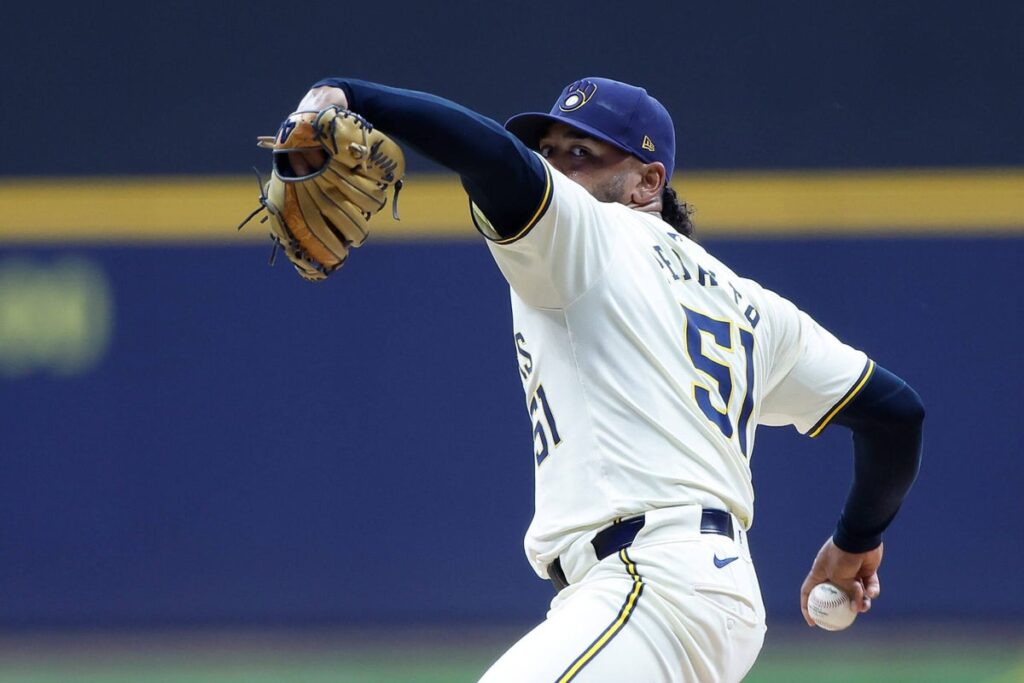
The Dodgers remain interested in Milwaukee Brewers right-hander Freddy Peralta, a two-time All-Star approaching his final season before free agency. Peralta is one of the top starters on the trade market after logging a career-best 2.70 ERA over 33 starts for the National League Central champions.
Given the injuries that plagued the rotation last year, trading for Peralta is worth exploring.
Blake Snell, Tyler Glasnow, Roki Sasaki and Emmet Sheehan all spent time on the injured list last season, and Shohei Ohtani didn’t throw a pitch until mid-June. The Dodgers are already apprehensive about protecting their rotation usage. Manager Dave Roberts hinted in December at a potential six-man or hybrid rotation to open the season as a way to best mix in extra rest and recovery days. The Dodgers have the depth to operate this way. Along with Sheehan, pitchers Gavin Stone, River Ryan, Ben Casparius and Justin Wrobleski are all capable of mixing in spot starts, and all have options remaining.
But some of that depth could be used to acquire another top-tier starter in a trade. Controllable starting pitching is always at a premium, and the Dodgers are one of the few organizations with a surplus. The Brewers, should they elect to trade Peralta, are believed to be coveting a major-league-ready replacement in a return, per The Athletic’s Will Sammon and Ken Rosenthal. The Dodgers match up well in that regard, especially given the Brewers’ penchant for pitching development. Any of the above names could be dealt in a potential package.
That the Dodgers have yet to dip into their prospect capital this winter gives them another leg up in any bidding war. Beyond the major-league roster, the Dodgers’ farm system also remains one of the top in the sport. With both of the Dodgers’ top acquisitions coming via free agency, Los Angeles is in a position to utilize its rich prospect pool, including talent already on the 40-man roster. After two disappointing seasons and a shift to a relief role in Triple A last year, Bobby Miller is now a trade candidate, though his value has dropped dramatically.
The addition of Tucker makes outfielder Ryan Ward, 27, expendable. Ward raked in the Pacific Coast League last year, slugging 36 homers with a .290 average and a .937 OPS. The Dodgers considered platooning him and Alex Call if they did not land Tucker. Now, Ward’s place on the roster is redundant, and the offensive numbers he put up in Triple A could be enticing for a team looking to add to its outfield depth.
The crop of young, controllable talent within their system shows the Dodgers can make a trade for Peralta. But they will only complete a trade if they believe there is a real need for him. Los Angeles’ willingness to engage in Peralta’s market shows at least some concern over the health and durability of its starters. Yoshinobu Yamamoto was the lone starter not to spend time on the IL last year.
Ohtani will be used as a true starter in 2026, but he’ll need extra days of recovery and won’t be used on the traditional five days’ rest. Sheehan delivered an encouraging campaign after missing most of the first half while rehabbing from Tommy John surgery. Still, the Dodgers will watch his usage as he prepares for a full season.
Sasaki’s success in the playoffs as a reliever won’t change his role heading into the season. He’ll be back in the rotation. However, he too will need built-in recovery days. Sasaki made just 10 starts as a rookie, as right shoulder pain shut him down for most of the season. Snell missed time from April to August because of left shoulder inflammation. The Dodgers will operate with discretion when it comes to his usage.
Even if all six starters — including Sheehan — break camp healthy, the Dodgers would be wise to prepare for injury. Pitching injuries continue to rise across the league, and teams generally see the largest uptick in arm injuries in March and April. Adding Peralta — who has logged 30-plus starts in each of the last three seasons — would give Los Angeles insurance coming into a spring in which the club will operate conservatively with its staff.
There’s also the financial aspect. Peralta will make $8 million in 2026 (not that the Dodgers are too concerned about that). But the Dodgers could be in a position to sign Peralta to an extension, one far more lucrative than the Brewers could offer.
Now, this is all assuming the Brewers decide to trade Peralta. Milwaukee holds the leverage here. It does not need to part with its best pitcher, particularly with the Chicago Cubs threatening to overtake the division after signing Alex Bregman. But the Brewers excel at identifying cheap and controllable talent, and the Dodgers match up well as a partner. As long as the Brewers are listening, the Dodgers will engage.
And as they’ve shown once more this offseason, the Dodgers can’t be ruled out of anything.